Sunny South
Mariners' Museum, Uncurated Search Results
Type: Schooner
Year: 1855
Builder: W. Skinner & Sons
Location: Baltimore

These records are found in the online catalog of The Mariners’ Museum and Park in Newport News, Virginia. Uncurated search results are presented to give researchers and interested readers an idea of whether the museum’s archives contain information about this vessel and whether it may be worthwhile to visit the museum’s catalog search page for further investigation. Uncurated results may be inaccurate or incomplete.
Search mode: Exact Name. Search phrase(s): "Sunny South". Results returned: 11. Results displayed in this table: 11.
Use these buttons to send uncurated search results to your own app or text document for further research. First, check the box for any row, or click "Select All" then uncheck any rows. Then click "Show Selections". You can then copy your selections from the text box and past them into your app.
| Fetch? | Row ID | Media | Date | Vessel | Place | Related Places | Inscription/Marks | Subject | Notes | Archive Number |
|---|---|---|---|---|---|---|---|---|---|---|
| 1 | No image URL. | Newport News Shipbuilding and Dry Dock Company. Transportation department. | Snow removal; Weather–Economic aspects | Sunny south | LB100971 | |||||
| 2 | 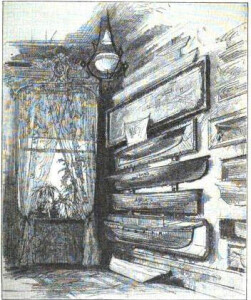 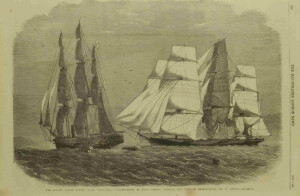 | SHORT DESCRIPTION: Builder’s half hull model, port side, of extreme clipper Sunny South built by George Steers in 1854. The model is a basic representation of the vessel's molded lines, without constructional details or embellishment. The model is inscribed, with the letters outlined black (i.e. not inpainted) “SUNNY-SOUTH.” The model does not have a backing board. The dimensions of the model are 59-3/8” (length overall) x 5-3/4” (main breadth), 5” (half breadth), ¾” tumblehome, 9” (height overall), and 7-11/16” (height amidships). The model scale is approximately 1:30 The model is constructed of 24 wood lifts. The lower 18 are flat, arranged in pairs, each pair consisting of a 17/32" lift, possibly pine, and a 3/32" lift of a darker wood, possibly cedar. The sheer curve is cut into the 19th lift, which is about 3/8" thick amidship, 2-1/6" at the stem, and 1-3/16" at stern. Above the sheer curve are five more lifts, each of uniform thickness from end to end but curved to follow the sheer; they represent the lower molding or wale (about 1/16"), topside planking (11/16"), deck-level (?) molding (1/16"), bulwark planking (15/16") and caprail (1/16"), the last being the top covering for the model. The minimum half-breadth of the model is a uniform 3/32" along the edge of the stem and 1/8" on the sternpost. There is curved "rocker" in the forward part of the bottom, beginning about 17" back from stem, with the lowest pair of lifts disappearing about 9-3/4" from the forward perpendicular. The stem is moderately raked. There are 12 station lines inscribed on the front of the model; most are 5-1/2” to 5-5/8” apart. The station lines at the stern are 2-7/8” apart and the station lines at the bow are 6-1/8” apart. The sixth station (from the bow) line runs through the “O” and “U” in the ship’s name. At the stern, the counter is rounded to produce an hourglass-type shape. There is an elongated loop-shaped pair of double lines inscribed on the counter that run from the back of the model towards the 21st bulwark planking lift that encompasses a raised area that starts at the 9th station line and becomes a pronounce bulge at the turn of the counter. This may have been the location of the stern cabin/windows on the back of the ship. The transom/bulwark planking lift (23rd) begins angling outwards at the top of the inscribed line to produce a stern overhang. The lifts may be held together with wooden pegs. There are numerous smaller holes whose purpose is not apparent on both back and top sides. The three lowest lifts at the stern are damaged, with a 4-3/8” section of the two bottom lifts missing. The third lift has damage that indicates the missing piece was nailed onto the 3rd lift at some point in the past. There is now wood missing from around that nail’s groove. There are small sections of the caprail missing at the stern and near the bow. At the bow, the 8th, 9th and 15th lift are missing their ends giving the stem a rather ragged appearance. There is some separation between the 6th and 7th lifts at the bow. The forward edge of the 3rd lift has minor losses and about an inch of the 1st lift is missing at the bow. NOTES: Text from The Search for Speed Under Sail 1700-1855 by Howard Chapelle, page 380: Another extreme clipper built in 1854 was Sunny South. This vessel’s registered dimensions were 144’8” x 31’4” x 16’6” and she was designed and built by George Steers at Williamsburg, New York…She was diagonally strapped, well-built, and handsomely finished. This vessel measured 135’4” between perpendiculars, 30’4” bean, 17’3” moulded depth, and 17’9” loaded draft. She had black topsides, varnished bottom, and a gilded sea-serpent figurehead…She had a marked and handsome sheer; rockered keel; strongly rounded forefoot; moderately flaring stem rabbet; nearly vertical post; raking, deep-V transom with rudder stock passing through it; long, sharp, concave entrance; long, fine, and concave run with the buttocks straight forward of their intersections with the after load line. The midsection had strong rise to the straight floor, a rather hard turn of the bilge, and much tumblehome above. On a draft of 17’9” her moulded length of load line was 149’ and her moulded displacement was 901.1 tons. Her coefficients were block .43, midship .78, and prismatic .62. Effective length of the quarterbeam buttock was 118 feet, camber 12’6”, giving her a camber-length ratio of 9.4. NOTES: From The Charleston Daily Courier (Charleston, South Carolina) September 12, 1854: New York September 7th, George Steers, the famous yacht builder, launched his first clipper ship, the Sunny South, this morning. She is said to be one of the most beautiful specimens of naval architecture afloat. Much is expected of her sailing qualities. She will first go to Rio Janeiro, though originally built for the China trade. NOTES: From the Daily Alta California, San Francisco, California, U.S.A., May 1, 1855: A brief description of the Sunny South may not be uninteresting to our readers, the ship was built at the foot of Eleventh street, New York City, by George and James Steers, and launched in September last and is owned by Wm. A. Sale, Esq. of New York. Cost about $70,000. Compared with such ships as the Tornado, Water Witch and Sovereign of the Seas, she is a small ship, registering only 745 tons. Her carrying capacity is about 1000 tons measurement goods. Her extreme length at the load-line is 154 feet. Extreme breadth of beam at the load line 31 feet 3 inches. Breadth on deck 28-1/2 feet. Depth of hold is 15-1/2 feet. Main yard 66-1/2 feet. Main sky-sail yard 24 feet. She draws 16-1/2 feet when loaded one foot more than her depth of hold. She has 28 inches dead rise. A handsome sheer gives a light and fancy appearance to the long and sharp bow, which is ornamented with a scaly monster as a figure head, with a long and very crooked tail. The lines of the bow an slightly concave, and the greatest breadth of beam is abreast the main hatchway. The run is a fine one but why Mr. Steers put such an ugly stern, upon an otherwise beautiful vessel, we cannot surmise. She is built entirely of white oak, with locust trenails. She is lightly and neatly sparred, and for speed we would pit her against any vessel that ever entered San Francisco harbor. Capt. Gregory gives her all praise as a sea boat good on all tacks. She was so deeply loaded on her passage out, that no opportunity was offered for testing her sailing qualities. She will sail for Hong Kong soon, and we expect to hear a good report from Capt. Gregory, on his arrival in New York. NOTES: Text from “The Clipper Ship Era: An Epitome of Famous American and British Clipper Ships, Their Owners, Builders, Commanders, and Crews 1843-1869” by Arthur H. Clark, pages 250-252: The Sunny South, of 703 tons register, was one of the prettiest clippers ever launched at New York, and was the only sailing ship built by George Steers, the designer of the yacht America, steam frigate Niagara, and Collins Line steamship Adriatic. She was built for the China trade, was launched at Williamsburg, September 7, 1854; was owned by Napier, Johnson & Co., and was commanded by Captain Michael Gregory. It is a singular fact that while this ship was well known to possess great speed when in company with other clippers, yet she never made a passage worthy of being recorded, and was not a very successful ship financially; although the product of the skill of a designer, who, dying in early manhood, left a name so interwoven with his country's triumphs upon the sea that it can never be forgotten. In 1859, the Sunny South was sold at Havana, her name being changed to Emanuela. At that time her royal studdingsail booms and skysail masts and yards were removed. On August 10, 1860, she was seized in the Mozambique Channel flying the Chilean flag, with a cargo of slaves on board, by the British man-of-war Brisk. The details of the capture were supplied in the Illustrated London News, December 8, 1860 on page 530: Capture of a Slaver by her Majesty’s Ship “Brisk.”: Her Majesty’s ship Brisk has recently captured a slaver, the Sunny South [actually named Emanuela], in the Mozambique Channel. A correspondent on board the Brisk, to whom we are indebted for the sketches in connection with the surrender of the slave-ship from which are illustrations on pages 527 and 546 are made, supplies us with the following particulars of the chase and capture of the Sunny South: At 11:30 a.m. on the 10th of August last, as her Majesty’s ship Brisk, Captain De Horsey, bearing the flag of Rear-Admiral the Hon. Sir Henry Keppel, K.C.B., was running to the northward in the Mozambique Channel, a sail was reported as seen from the masthead. Steam was got up without delay, and sail made in chase. It being hazy, the stranger was shortly afterwards lost sight of. When the weather had partially cleared the stranger was reported four points on our starboard bow, and the ship’s course was altered in that direction. We were now going eleven knots and a half an hour, and the Captain, feeling convinced that it must be something out of the common that could alter bearings at that distance in so short a time, proceeded himself, with his glass, to the fore-topmast-head, officers mounting the rigging. That a general excitement prevailed was evident from the manner in which our sails were trimmed, taken in, and set again. Hottentots and landsmen, who on other occasions only looked at ropes, now laid hold of them with a will. The Captain's order from the masthead to keep away two points showed that he had observed something suspicious—in fact, he had noticed a sudden alteration in the course of the chase, and pronounced her to be a long, rakish-looking ship, too large to be a slaver, but thought there was something very suspicious in the sudden alteration of her course, her crowd of sail, and the unusual number of staysails. At about 3 P.M. we could see her hull from the deck, and, carrying with us a fresh breeze, while she was in the doldrums, we closed on her rapidly. When within half a mile we hoisted our colors, when every glass was pointed toward her peak, and all sorts of conjectures were made as to what colors she would show. No one could imagine that so large a vessel could be a slaver. On closing under her lee, and when within a cable's length, a white package was thrown from her side into the sea; and the experienced then exclaimed, “A slaver, and there go her papers!' A few minutes more, and we sheered up alongside to leeward of as beautiful model of a ship as ever was seen. Some forty dejected looking individuals, apparently a mixture of all nations, stood on her deck; still no colors, nor did she appear inclined to shorten sail or heave-to. The Captain then determined to run ahead and lower the quarter-boats to drop down and board; and as this maneuver was being carried out a blank gun caused her to square the mainyard, which she did with studdingsails hanging to the yard, and luffed up into the wind. It was an anxious five minutes to those on board while the boats were away. A small white British ensign run up at her peak showed that she was a prize, and a voice hailed us, “850 slaves on board!” She proved to be the Sunny South, of 702 tons, built at New York in 1854, and sold at Havannah in 1859, valued at 20,000 dollars, and considered to be the fastest vessel in that port. She sailed from Havannah, on the 5th of March, under the Chilian flag and name of Manuela, having cleared for Hong-Kong. Her slave-deck is seven feet high, and although there were 846 slaves on board, she was not at all crowded in comparison to other vessels so employed. In addition, she carried a crew of 40 in all, including a captain, mates, pilot and a doctor. Her dimensions are—length, 154 feet 8 inches; breadth 34 feet 4 inches; depth, 16 feet 6 inches. She was intended originally as a New York and Rio packet. NOTES: The collection of half models MR 5 through MR 24 are of vessels built by shipbuilders Henry (father), James Rich and George (sons), and Henry Steers (son of James Rich), builders of the famous yacht America. The models document vessels built between 1805 and approximately 1876. They encompass all types of vessels from a catboat up to large steam sloop built for the US Navy. In a February 13, 1963 letter Howard I. Chapelle, Curator of the Division of Transportation at the Smithsonian stated “The Steers Collection is important technically and it is something we envy the Mariners’ Museum’s possession.” VESSEL INFORMATION-- VESSEL NAME: SUNNY SOUTH VESSEL TYPE: Clipper Ship SERVICE DATES: 1854-1859 SHIP BUILDER: George Steers (also designer) BUILDER LOCATION: New York, Williamsburg VESSEL HISTORY: 1854 October 7: Launched at the shipyard of George Steers, Williamsburg, NY, for Napier, Johnson & Co., New York. Captain Michael B. Gregory. 1854 November 21 - April 12: Sailed from New York to San Francisco in 143 days after having put into Rio de Janeiro. 1856 March 1:Sailed from New York for ... 1858 April 14: Arrived in New York from Santos. 1859: Sold to Havana for $18,000 and was renamed Emanuela. 1860 March 5: Cleared from Havana for Hong Kong under Chilean flag. 1860 August 10: Captured by the British screw sloop-of-war HMS Brisk in the Mozambique Channel with more than 800 slaves aboard. Condemned as a prize and sold to the Royal Navy to be used as a cruiser. Eventually renamed Enchantress and used as a store ship on the African coast. 1861 February 20: Wrecked in the Mozambique Channel. SHIP OWNERS: Napier, Johnson & Co., New York ALL SHIP NAMES: (1) SUNNY SOUTH, (2) EMANUELA, (3) ENCHANTRESS | CL14554 | |||||||
| 3 | 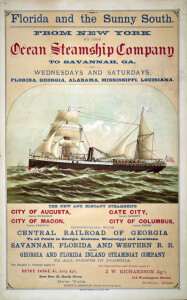 | VESSEL INFORMATION - VESSEL NAME: CITY OF MACON VESSEL BUILT: 1877 SHIP BUILDER: JOHN ROACH & SON SHIPBUILDER LOCATION: CHESTER, PENNSYLVANIA VESSEL DIMENSIONS: 2093 gross x 257.0 x 24.8 TRADE ROUTE: NEW YORK, FLORIDA Alternate vessel names: (1) CITY OF MACON (1877-1902); (2) LEXINGTON (1902-1923). | CL19723 | |||||||
| 4 | 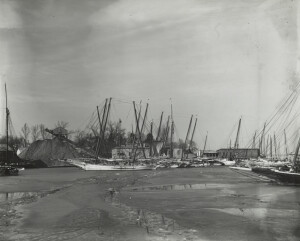 | 1917-1918 | Lola E. Bennett (Schooner : 1902). | Image features numerous workboats ashore at an oyster processing plant; in the background is a large pile of oyster shells. Pictured are: Lola E. Bennett (1902), Nettie B. Greenwell (1897), Willie H. White (1883), M.A. Sommers (1890), and Sunny South (1881). | P0001.008/01-099#PH1459 | |||||
| 5 | 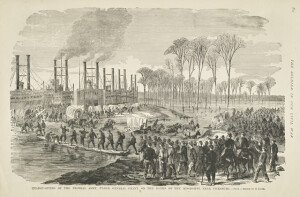 | SHORT DESCRIPTION: The print shows steamboats lined along the shore of the Mississippi River, near Vicksburg, Mississippi. There are six steamboats, and the Union troops fill the shore line. The area looks to be flooded, and the soldiers are crossing narrow stretches of water balanced on logs, some with their arms out. They are also on horseback or in covered wagons, with the water reaching the horses’ chests. NOTES: Print is from page 80 of “The Soldier in Our Civil War,” volume 2, published in 1890. The image also appears later on page 277 of “Frank Leslie’s Illustrated History of the Civil War,” published by Mrs. Frank Leslie in 1895 but is not an exact match. Mrs. Leslie was originally Miriam Florence Folline, though she added Peacock, Squier, and Leslie after various marriages. She married Frank Leslie in 1874, but he died in 1880. She then legally changed her name to Frank Leslie in 1881, which is how this book came to be published by Mrs. Frank Leslie. TEXT from 1895 “Frank Leslie’s Illustrated History of the Civil War”: “Our artist’s sketch needs no description-it explains itself. A more perfect picture of the Slough of Despond was never painted. General Grant established himself on board the Magnolia, where he superintended the entire operations. One of his aids wrote: ‘As for mud, it beats Broadway, and considerable fun is got out of the wallowings undergone by the commissariat wagons and their drivers. Frequently the men place logs at certain intervals, and crowds amuse themselves by seeing how often the log disappears, leaving the man who trusted to it up to his middle in that magnificent mud and slush, which throws even Virginia into the shade.’ The second boat to the right of the Magnolia is the hospital ship.” | CL18171 | |||||||
| 6 | 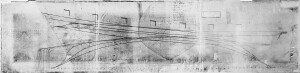 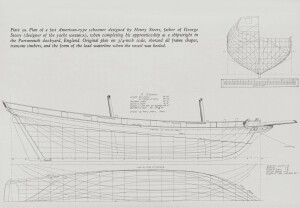 | NOTES: The drawing was originally framed when it came to the museum. The piece was stained and brown. The drawing was removed from the frame, cut in three sections and placed between two heavy cardboards for protection. In February of 1960 the piece was loaned to Mr. Howard I. Chapelle at the Smithsonian Institution for research purposes. The piece never returned to the museum and is presumed to have been lost by the Smithsonian. There is a photostat available of the drawing in the object file. Associated References: CN 1034 is a redrafting of the plan by Howard Chappelle. It was drawn for inclusion in the book "The Search for Speed Under Sail". NOTES: From Fast Sailing Ships 1775-1875, Their Design and Construction, by David R. MacGregor, page 56: It is interesting to compare the design of a fine-lined schooner which Henry Steers drew in 1805, whilst still an apprentice [at Portsmouth Dockyard] with the plan of the Shamrock. The schooner plan exhibits strong American influences and Howard Chapelle published it in his recent book [The Search for Speed Under Sail]. In the book "The History of the American Sailing Navy" Chapelle states this about Henry Steers: In 1819 an English shipwright named Henry Steer applied for work in the Washington Navy Yard. Steer was born at, or near, Dartmouth, England, in 1780. He learned his trade under a builder named Newman in New Quay, and after completing his apprenticeship he went to work in the Plymouth Dockyard. In 1815 he went to the island of Guernsey and worked for the French government. He was not only a shipbuilder, but also a competent draftsman and designer. A fellow shipwright in the Plymouth Dockyard, John Thomas, also a competent builder and designer, had gone to America and was working in the Washington Yard. Thomas wrote Steer suggesting that he come to America and, a depression occurring in the trade in Great Britain at this time, Steer and his family--wife and two sons, James R. and Henry T.--arrived in New York and went from there to Washington. A third son, George, was born in Washington in 1820. Henry Steer was employed on the schooners Shark and Grampus, apparently acting as charge man, and remained in the yard until 1822. His sons Henry and George became distinguished ship designers. The younger, George, designed the yacht America and many pilot boats, as well as the clipper ship Sunny South. Henry Steers (an "s" having been added to the name by usage) was the designer of the famous Collins steamer Adriatic and of many other noted vessels. It has sometimes been claimed that Steer designed the Shark and Grampus, but this can readily be shown to be an error (the vessels were designed by Henry Eckford). Interestingly this book was published in 1949 and in a February 13, 1963 letter to Mr. Robert Burgess, curator of exhibits at the Mariners' Museum, Chapelle states: "I now wonder if it could be a model of the USS Shark which Henry Steers worked on in Washington when he first came to the US." In the article “The Evolution of the American Yacht” by S.G.W. Benjamin in The Century Illustrated Monthly Magazine, Volume 24, pages 355 and 357 Benjamin also discusses Henry Steers and the USS Shark and provides a line drawing of the Shark that matches this model. NOTES: Information from Henry Steers, III: From a journal/autobiography of James Rich Steers transcribed by his son just before his death: "Henry Steers left Plymouth in the spring of 1815 with his family (a daughter, Ann, remained behind in England ) for the Isle of Guernsey, one of the Channel Islands, under contract as a draughtsman for a firm of shipbuilders. These shipbuilders had made contracts with some "French merchants" to build several sailing vessels for them, and to guarantee first speed, second, stability and third, safety. A ship design father had drawn up during his employment at the Royal Plymouth Dockyards in 1805 was accepted by the firm. Three vessels were finished from these lines and accepted." According to family lore these French merchants as it turned out, were smugglers--perhaps the reason that speed was deemed more important than safety. Father also built one bark that was ready to launch by the time he left in April 1819 for Washington. [could this model dated 1805 be related to the building of the vessels built for the French merchants?] NOTES Text from The Search for Speed Under Sail 1700-1855 by Howard Chapelle, page 189: It has been pointed out that the American sharp seagoing schooner had become so well-known abroad by 1800 that European constructors were able to produce schooners on the American model. Plate 50 is an example. It is a design made in 1805 by an English shipwright apprentice named Henry Steer or Steers. This drawing differs from the original in not showing every frame and in not having the heeled load waterline projected. The original plan seems to have been drawn by Steers as a final examination on completing his apprenticeship. There is no indication that the plan was built from, it was probably a project or a test of seamanship. The plan (plate 50) was for a large 12- or 14-gun schooner of the American model 90’10” between design perpendiculars, 90’10” on the upper deck, 23’2” moulded beam, and 9’9” depth in hold. The design is marked by heavy drag to the keel, strongly raking ends, strong sheer, a midsection formed with sharply rising straight floor, high and easy turn of the bilge, and with some tumblehome in the topsides. The entrance is sharp, convex, and rather short. The run is long and very fine, with hollow in the buttock under the quarters. [Willoz-Egnor, October 2, 2020: The plan Chapelle is referring to is an actual drawn plan that originally came to the Museum with the Steers collection of half models. Unfortunately the plan was loaned to Chapelle for study and was lost. See 1936.1508.000001 for a digital copy.] The projected schooner would have been 82’3” long on the moulded load waterline, with a moulded displacement of 176.3 long tons. Her block co-efficient was .36, her midship coefficient .60, and her prismatic coefficient .59. The effective length of the quarterbeam buttock was about 57’9” and its camber 5’5”, giving a camber-length ratio of 10.7. The apprentice designer of this schooner, Steers, came to America shortly after the end of the War of 1812, and was employed in Washington Navy Yard. He later removed to New York, where he and an associate built the first marine railway in that area. | CL6146 | |||||||
| 7 | 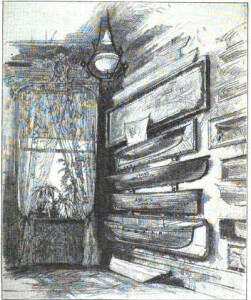 | SHORT DESCRIPTION: Builder’s half hull model, starboard side, that may have been George Steers’ design for a clipper ship. Date unknown. The model is a basic representation of the vessel's molded lines, without constructional details. The stubs of three masts were present at some point but none remain (one was present when the model was accessioned in 1936 but it is now missing). There is a false keel and false stem running from bow to stern. A sternpost is attached to the false keel with a hook scarf. There is another hook scarf near the bow connecting the false stem and false keel. The bowsprit is 8-3/4” long. The rudder is missing. The model is on a decorative backing board that is varnished; it is beveled (1-3/8” width at the bottom and an 1-1/4” on the top and sides) around the edges and the bevel is covered with a thin dark veneer. There is a small rail (3/16”) running along the edge of the model to produce a slightly inset deck. The lower 14 lifts are varnished and the top 8 lifts are painted black and varnished along with the bowsprit, wedge, and railing. The dimensions of the model are 73” (length overall including bowsprit, 68-1/2” without bowsprit); 5-1/2” (main breadth), 4-7/8” (half breadth), 5/8” tumblehome, 14-1/8” (height overall of backing board), and 6-5/8” (depth overall including the backing board). The overall length of the backing board is 79-1/6”. The model was built from 22 wood lifts. The lower 18 are flat, arranged in pairs. The bottom lift may be thicker and may have a small wedge at its base near the stern (together they measure 1-5/16”). It has a small lift above it that’s 1/16”. The remaining flat pairs (lifts 3 through ) include a 15/32" lift, possibly pine, and a 1/16" lift of a lighter colored wood. The sheer curve is cut into the 19th lift, which is about 3/8" thick amidship, 11/16" at the stem, and 1-3/16" at stern. At the stem between the 19th and 20th lifts is a wedge, which is 1-1/4” and tapers after 19-1/4”. Above it are three additional lifts, each of uniform thickness from end to end but curved to follow the sheer; the 20th lift is 1/16”, the 21st lift is 7/8”, and the 22nd lift is 1/16”. The last being the top covering for the model. The minimum half-breadth of the model is 1/32" along the edge of the stem near the keel and thickens to 1/16” near the bowsprit, and 1/8" on the sternpost. There is a curved "rocker" beginning about 19" back from stem, with the lowest pair of lifts disappearing about 10" from the forward perpendicular. The stem is raked. The hourglass shaped stern is flat and raked. The railing that runs around the top edge of the model is missing a 1” section where it meets the bowsprit and a 4-1/2” section that wraps around the stern. A small piece of the false stem is missing, at the point where it meets the false keel in a hook scarf. The thin 22nd lift is buckled, warped, and cracked on the top of the model just abaft of amidship. The stern is missing a small section of wood at the top edge. The veneer on the beveled edges is cracked in multiple locations and some of the inlay is lifting. The varnish and the paint have serious alligatoring (a form of traction crackle). On the reverse of the backboard there is water damage, which is also visible in two places along the front of the backboard at the top near the stem. NOTES: The collection of half models MR 5 through MR 24 are of vessels built by shipbuilders Henry (father), James Rich and George (sons), and Henry Steers (son of James Rich), builders of the famous yacht America. The models document vessels built between 1805 and approximately 1876. They encompass all types of vessels from a catboat up to large steam sloop built for the US Navy. In a February 13, 1963 letter Howard I. Chapelle, Curator of the Division of Transportation at the Smithsonian stated “The Steers Collection is important technically and it is something we envy the Mariners’ Museum’s possession.” NOTES: Howard Chapelle, in his book "Search for Speed..." on page 380 states: "...Steers also made a model for a larger clipper ship that was never built, intended to be an improvement over Sunny South [MR 19]. The half-model of this project is in the Mariners' Museum, Newport News, Virginia." It is believed that the model Chapelle is referring to is this model of an unidentified, and presumably never built clipper ship. According to Naval Architect and Marine Engineer Karl L. Kirkman in "The Broadaxe" (newsletter of the Shipmodel Society of New Jersey) after the success of the schooner yacht America in 1851 Steers attempted to market a large clipper ship based almost entirely on the yacht America's form and that our model, MR 12, may have been used to demonstrate Steers' concept to potential backers. This would explain the nice, beveled backing board and the decorative lifts rather than a traditional builders model which would have been used to develop the hull form for laying down in a mold loft. Mr. Kirkman also believes that this particular model is illustrated in the July 1882, No. CCCLXXXVI, Vol. LXV issue of Harper's New Monthly Magazine in which appears an image of Henry Steers' Model Room--the fourth model from the bottom. NOTES: Carl Cutler states on pages 273 and 274 in Greyhounds of the Sea, The Story of the American Clipper Ship: George Steers, who designed America, was becoming interested in clipper ships. During 1853 he made a model of a 2500 ton ship very much like the America, but improved in various particulars, and calculated to sail at least twenty-two miles an hour....It is to be regretted that Steers never found a merchant sufficiently venturesome to build a ship from this design, since he had evidently retained many of the features of the Baltimore clipper type, and in addition had forecast much that is still embodied in modern yachts and fast fishing schooners. Such a ship would doubtless have proved remarkably speedy under normal weather conditions, whatever her capacities might prove to be tested off Cape Horn or on the Australian turnpike. NOTES: A reporter for the New York Herald included a description of the model in a lengthy interview with the designer, published in the Sunday edition, November 6th, 1853: "And now Mr. Steers has constructed a model of a ship of 2,500 tons, for the California and New York trade, of which he is to be the owner himself, in part or exclusively, and which he undertakes will sail twenty-two miles an hour, beating any steamer that has ever yet floated. He will sail her, when finished, against any ship in the world for $10,000. Though her exquisite form, at a first glance, strikes you as being the same as that of the America, and it is, in point of fact, in all the leading features the same, yet on closer examination you will detect improvements even on that unrivalled model. Like the America, her keel tapers from the stern to the stem, 'growing fine by degrees, and beautifully less,' and her 'fore foot' is cut away-that is, the angle formed at the bottom of the bow and junction of the keel in other vessels, is completely rounded off, and the entire line along the bottom of the keel, beginning at the helm, and ending at the top of her prow in nothing, is almost one beautiful curve. She is thus far deeper behind than before "Like the America, too, her stern is sharp and tapering as well as the bow, that being necessary for easy clearance of the water, as the sharpness of the bow is for easy entrance; but, though the portion of it under water is made quite thin, the edge is not raked or cut away underneath, like the bow, but is nearly straight up and down, thus presenting a large area of perpendicular surface as a balance of resistance to the water, for the resistance of the almost perpendicular surface of the side of her bow at the lee-side, caused by the present of the wind on the sails, aided by the fact of the weather bow being raised out of water when the ship is going fast and therefore presenting little or no resistance to her tendency to turn round into the wind: what is cut away therefore from her bow is added to her stern. All this is contrary to the English models, which are nearly perpendicular in the stem, while the stern is raked. They are also bluff in the bows. "Again, the model of the proposed ship is like the America's in being neither wall-sided and rounded at the bottom, nor bellied, but straight from the waterline to the keel, thus presenting the strongest kind of side resistance to the water. The model is also very wide and shallow, giving great stability. It tapers so beautifully from the center that the eye cannot find the exact central spot-just like the well formed leg of a woman,' from which Mr. Steers says he borrowed his idea." | CL14547 | |||||||
| 8 | 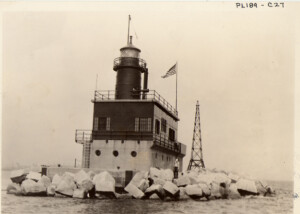 | USA; ILLINOIS | NOTES: The plain, modern lights that mark Calumet Harbor today reveal little about Calumet’s earlier lighthouses and the colorful personalities that staffed them. The first light was established built in 1853 at a cost of $4,500 using stone quarried in Blue Island and transported down the Little Calumet and Calumet River by barge. A.G. Golton served as the first keeper. However, ship captains heading for the Chicago River were confused by the new light, and due to numerous protests, the light was extinguished on July 28, 1855. The lighthouse was sold at auction for $125, but in 1870 the government wanted to reactivate the light and had to buy it back for $10,000. The light shone again from the shore for three years, until it was replaced by a pier light. As the harbor works were improved, this light was moved in 1884 and rebuilt in 1898. This mural shows both the 1853 lighthouse and pierhead light. Mary M. Ryan is the most notorious keeper of the Calumet Lighthouse. Following the death of her husband, she assumed responsibilities for the light on August 10, 1873. Mary Ryan remained at the post for over seven years, which given the following sampling of her log entries, might have felt like an eternity. Dec. 4, 1873 Wind so bad, I think it will blow the tower over. Dec. 25, 1873 I was supposed to have been informed when this light would be discontinued, not a vessel since the 15th of Nov. and nothing to light for and this is such a dreary place to be all alone in. April 7, 1874 So dull, in this place it is killing me. Wind blowing violently. April 15, 1874 Oh, for a home in the sunny south, such a climate. April 16, 1874 Such a time, everyone is in despaired think summer is never coming. May 1, 1874 So cold, mayday, those people who goes for flowers will be disappointed. May 2, 1874 Nothing but gloom without and WITH IN. Oct. 31, 1874 The promise of a cold hard winter as old signs goes, so many out of employment at this early season, and what will it before winter is over? God “only knows.” May 31, 1874 So dull in South Chicago. This place is growin down all the time. April 22, 1880 I think some changes will have to be made this is not a fit place for anyone to live in. July 31, 1880 This has been the most trying month of my keeping a light house, the most important question, can anything worse come? Aug. 28, 1880 The light house Engineers never do anything for me. Aug. 30, 1880 Oh what a place. Oct. 1, 1880 The news is that the light will soon go from me forever. Nov. 1, 1880 This is all gloom and darkness. In 1899, the construction of a breakwater to create an artificial harbor at the entrance to the Calumet River was authorized. Starting from a point roughly a half mile north of the river’s entrance, a breakwater was extended out into the lake. The breakwater is formed of timber cribs capped by concrete, and projects east into the lake for about 4,000 feet before bending to the southeast. At the end of this 6,714-foot breakwater, work on a lighthouse began in 1905. The stout, rectangular structure originally consisted of two full stories, topped by a pitched roof, with a cylindrical tower extending above the roof at one end. Later, the pitched roof was removed, and the tower stood alone atop the boxy building. For several years, both the pierhead and outer breakwater lighthouses were active and maintained by keepers in season. A lifesaving station was located on the Calumet River, and one of the station’s lookout towers was positioned near the pierhead lighthouse. When the surfman stationed at the lookout saw the flag at the outer breakwater lighthouse flying at half mast, he knew the keepers required assistance. Thanks to the lifesaving station logs, several instances of the keepers lowering their flag to signal the lookout tower were recorded, including the following one. Early on the morning of April 16th 1921, the surfman on lookout noticed the distress signal was being flown at the outer breakwater lighthouse. A gale wind was blowing, the seas were very high, and the temperature was just above freezing. As the lifesaving station’s lifeboat was out of commission, a rescue team was forced to request that the M.B. Mary tow their surfboat to the lighthouse. Accompanied by two keepers of the pierhead lighthouse (James Muckiam and Joseph Gramm), the crew rowed the surfboat the final few yards up to the lee side of the lighthouse. The lifesaving keeper recorded that “the windows of the lighthouse were broken in. The floors flooded. The building shifted about two feet, breakwater going to pieces around it and other places.” Still, the keepers refused to leave the lighthouse. They did, however, request that the lighthouse superintendent be informed of their situation. After returning to shore, the lifesaving keeper telegraphed the superintendent, who gave his permission for the keepers to be removed from the lighthouse if their lives were endangered. The lifesaving keeper judged the lighthouse keepers’ situation to be quite grave, and they were accordingly brought ashore with the assistance of a tugboat. The mouth of the Calumet River and the surrounding land all lie within the state of Illinois, however due to the length of the breakwater, the breakwater lighthouse was actually just east of the Illinois-Indiana State Line, which runs north-south. Since the lengthy breakwater is exposed to the full force of northern storms that can sweep the length of Lake Michigan, over 12,000 tons of rip rap were placed along it in 1930 for protection. Armand Seguin was stationed at the lighthouse in 1961-1962. During his service, the lighthouse was generally staffed by two Coast Guardsmen who spent four days at the lighthouse followed by two days off. Seguin remembers that there were two bedrooms, a kitchen, a bathroom, and an office/living room on the upper level, while the lower level housed the furnace, a water tank, and the air compressor for the fog signal. The US Steel South Chicago works provided electricity to the lighthouse for free via a submarine cable. The only catch was that it was AC at 25Hz. This meant that the lights flickered, and while a motor/generator was used to convert the electricity into a standard 110V and 60Hz signal for powering a television, the picture would periodically get off sync. Inspectors from Chicago visited the station and found that the well water was contaminated. When Sequin inquired how bad it was, the inspector replied "Well, you might take a bath in it, but don't get it anyplace by your face! And, boil it like mad before you cook with it." From then on, the Coast Guardsmen had to haul their own drinking water out to the lighthouse. A second detached breakwater with a length of 5,007 feet was built to provide further protection for the harbor. A small gap, which provides a direct route to the river from the lake, separates the two breakwaters. A good recent view of the Calumet River and Harbor can be seen in this photograph. In 1995, the two-story, breakwater lighthouse was demolished over a period of 22 days. In its place, stands a white cylindrical tower marked with a red band, as seen in the bottom photo to the left. The nearby end of the detached breakwater is marked by a similar tower with a green band. The steel tower standing on four cylinders shown in the top two photographs marks the other end of the detached breakwater. | P0001.012/01-#PL189 | ||||||
| 9 | 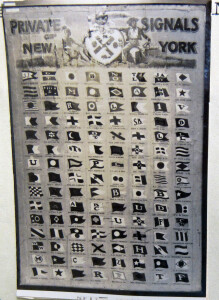 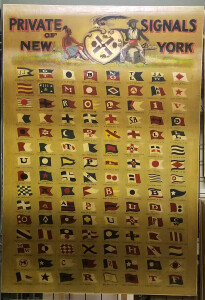 | NOTES: For additional information see Kenneth Blume's "Historical Dictionary of the U.S. Maritime Industry" Scott & Morrell were merchants and shipping agents who were active in the 1830s and 1840s. The company appears in newspapers as Scott & Shapter at 72 and 74 South Street as early as 1829, then as Scott, Shapter, & Morrell in 1833. In 1837 the newspaper advertisements list their company as Scott & Morrell. E.D. Hurlbut & Co. was founded in 1825 and operated three lines by 1850 (Apalachicola, Mobile, and Pensacola). They were located at 84 South Street in and also added service to Havre and Antwerp. Goodhue & Co. began in 1808 as Goodhue & Swett, became Goodhue & Co. at 44 South Street by 1816. The company dissolved in 1861. Duberceare should be spelled Duberceau. Edgar Duberceau and L. Bouquet appear as merchants in the New York City Directories and Wilson's Business Directory of New York City from the mid 1840s through the 1850s. Their address was 28 Old Slip and later 142 Pearl. Napier Johnson & Co. owned the ship, Sunny South, which was designed by George Steers who also designed the yacht America. (From "The Clipper Ship Era: An Epitome of Famous American and British Clipper Ships, Their Owners, Builders, Commanders, and Crews 1843-1869" by Arthur Hamilton Clark, 1912) Grinnel Minturn & Co. should be spelled Grinnell. They operated a blue swallowtail line to Liverpool from 1822 to 1880, a red swallowtail line to London from 1823 to 1880, and a California Line starting in 1851 with the Gold Rush. The company began as Fish & Grinnell around 1810, and became Grinnell & Minturn in 1832. (See Whaling Museum of New Bedford and also "The Old Merchants of New York City" by Joseph Alfred Scoville, 1863) Spofford & Tillitson should be spelled Spofford & Tillotson according to Arthur Hamilton Clark's book and newspapers from the 1870s. Zeraga should be spelled Zerega. From pages 752-753 of Henry Hall's 1895 book "America's Successful Men of Affairs," Augustus Zerega was born in 1803 in Martinique. He moved to America around 1835, then started his Z Line of clipper sailing ships. He retired in 1855 and died in 1888. His most famous ship is possibly the Antarctic, which saved several hundred passengers and U.S. service members from the SS San Francisco, which sank off the coast of the Carolinas after a storm in December 1853. 1852 New York City Directory lists the company as shipping merchants at 56 South. Kermitt & Carrow should be spelled Kermit & Carow. Robert Kermit started a packet ship business with his brother in 1817, going to and from Liverpool. After his brother's death he joined with Isaac Carow to create Kermit & Carow, then married Isaac's daughter Ann Eliza in 1832. Ann Eliza's brother, Charles Carow, joined the firm after his father's death. Charles' daughter, Edith Kermit Carow Roosevelt, was the wife of President Theodore Roosevelt. Howland & Aspinall should be spelled Howland & Aspinwall. Founded in 1826 as G.G. & S. Howland by Gardiner Green and Samuel Shaw Howland (Mayflower descendants). In 1832 William H. Aspinwall (a brother-in-law) joined the firm and it became Howland & Aspinwall between 1836-1837. The Howlands retired in the 1850s but the company continued through 1895 in name only. (See Kenneth Blume's book "Historical Dictionary of the U.S. Maritime Industry") Post & Philips should be spelled Post & Phillips. The New York City Directory of 1843 lists them as agents at 68 South Street. W. & J.T. Topscott should be spelled W. & J.T. Tapscott. William and James Tapscott were agents with William located in Dublin and Liverpool, and James in New York. Their newspaper advertisements list them at 43 Peck Slip, next door to 151 South Street, in 1838. A large fire destroyed their buildings in 1850 but they rebuilt. Whetmore & Cryder should be spelled Wetmore & Cryder. From “Rites of Passages: The Wetmores of Chateau Sur Mer” William Samuel Wetmore had several partnerships but “revisited his partnership” with John Cryder of Philadelphia in 1844 to form Wetmore & Cryder. Wetmore retired from that in 1847. Johnson & Lowden appear in Longworth's American Almanac as merchants at 86 Wall Street in 1841 and in Annual Report of the New York Association for Improving the Condition of the Poor in 1857. Siffken & Ironside were merchants at 56 Broadway when a fire destroyed the block in 1845. Francis E. Siffken died in 1880, his obituary (New York Times, 12 February 1880, page 2) states that the company survived the panic of 1857 and lasted until Mr. Siffken retired in 1870. Bucklin & Crane began in the mid-1840s with Thomas Peck Bucklin and Isaac B. Crane. The company owned the ship Comet, and lasted through the 1880s. (See bucklinsociety.net) William Whitlock, Jr.'s father was a shipowner and Jr. joined the company in 1812, then created his own company in 1825. This lasted until the Civil War. David Ogden was an agent for a line known as the St. George Line (for the St. George cross on their house flag) and occasionally as the Red Cross Line. Appears to have been most active in the 1850s. N.L. & G. Griswold: Nathaniel Lynde Griswold and George Griswold started the company in 1822, then continued through the California Gold Rush. The John Griswold/London Line began in 1823 by John Griswold, also known as Griswold's Black X Line for the house flag. The line ran between New York and London until 1867. Barstow & Pope began with Henry W. Barstow, William P. Barstow, and Joshua L. Pope; Longworth’s American Almanac lists them as commercial merchants at 98 Pine in 1841 and 1842. Goulding’s New York City Directory of 1877 lists them at 26 Burling Slip. Mason & Thompson were active in the 1840s and 1850s as merchants and shippers with business in South America, the Caribbean, and San Francisco. Taylor & Merrill’s Black Star Line was owned by Robert L. Taylor and Nathaniel W. Merrill and operated between the 1830s and 1850s between New York and Liverpool and in the China Trade. They also worked in the slave trade to Savannah in the 1840s. Williams & Guion: Stephen Barker Guion and John Stanton Williams founded the company in 1843 when Guion was 23. They worked in the transatlantic trade and started a packet line called Black Star Line. In 1852 Guion moved to Liverpool to start Guion & Co., agents for Williams & Guion. In 1866 they added their first steamship. When John S. Williams died in 1876 the company became Guion & Co. in 1883. M. & R. Maury: Matthew and younger brother Rutson Maury started the company in 1832 but changed in 1841 to Maury Brothers. Matthew served on the Chamber of Commerce from 1838 until his death in 1877. In 1835 M. & R. Maury was located at 35 Broad Street. Fox & Livingston: Francis D. Fox and Mortimer Livingston, the company lasted from 1820s to 1850s, was named Bolton, Fox, & Livingston when first established. They were merchants, traders, and shipowners. Moses Taylor worked for Howland & Aspinwall until he turned 26 in 1832 and started his own company. His offices were on South Street but a fire destroyed his offices but rebuilt and became very successful. He was involved in Boss Tweed and Tammany Hall, and what is now Citibank. Josiah Macy & Son was founded in 1822 by William H. Macy and began using this name when his father, Josiah Macy, joined the firm in 1828. As William's brothers grew older they joined the firm and the name became Josiah Macy & Sons, which lasted until Josiah Macy Sr. retired in 1853 and the name became Josiah Macy's Sons. (From William H. Macy's obituary, The Boston Globe, 20 May 1887, Page 4) They filed for bankruptcy in 1900. Laidlaw & Whitlock: (from “Biographical Register of Saint Andrew's Society of the State of New York” page 152) John Laidlaw was involved in commission business in 1822 at 106 Front Street, then in 1826 he was at 78 South Street where he was an agent for a line of packet ships to New Orleans. Around 1831 he started Scott & Laidlaw with John Scott but Scott left soon and in 1835 the company became John Laidlaw & Co. and in 1840 it became Laidlaw & Whitlock. He was alone in business by 1842 at 175 Front Street. Samuel Thompson & Nephew (From Mystic Seaport finding aid) Samuel Thompson started the company in 1825 and it was under his name until 1845 when it became Samuel Thompson & Nephew. It became Samuel Thompson’s Nephew & Co. in 1870. They worked as agents for numerous vessels and worked in the immigrant trade in the 1840s and 1850s. It also managed the Black Star Line of Liverpool packets. Samuel is related to Jeremiah Thompson who helped start the Black Ball Line in 1817. Union Line/Havre began in the 1820s as the Havre Line, then the Old Havre Line, then merged with other companies to form the Union Line. George Sutton operated a line of ships to Charleston (not Charlestown as the sign reads). He built several homes in New York City, at least one of which still stands at 143 Allen Street. A.A. Low & Brothers was Abiel Abbot Low whose firm specialized in the China trade and owned the ship Hoqua. In 1840 he started his own company after learning the trade, worked with his brother Josiah Orne Low. (From Low Family Papers at Peabody Essex Museum) Chas. R. Green stood for Charles R. Green, who was a junior partner in George Green & Brother by the 1830s. George died in 1847 and Charles took over, moving the company to Wall Street in 1849. (From “The American Clipper Ship, 1845-1920”) J. Howard & Son was Joseph Howard and his son, John Tasker Howard. They moved to Brooklyn from Salem, MA in 1827. (From “Some Memories of John Tasker Howard, 1808-1888, and His Wife, Susan Taylor Raymond, 1812-1906” 1909) C.W. & A. Thomas was Cornelius W. and Augustus Thomas. They began working with their father Thomas Thomas, then from 1838-1847 the company was T. Thomas & Co., and from 1850-1852 it was C.W. & A. Thomas, then it became A. Thomas & Co. (From NYC Landmarks Preservation Commission May 15, 2007) B. Aymar & Co. was Benjamin Aymar and his brother John Q. Aymar. They started the company in 1821 and moved to 34 South Street in 1825. According to the 1870 publication "The Old Merchants of New York City," volume 3, the company was still in business. Taylor & Rich is probably Taylor & Ritch, though it occasionally appears as Taylor & Hitch/Hich. William C. Taylor and Henry Lockwood Ritch both appear in federal census records as merchants or seaman, and in New York City directories at 136 Front Street. Taylor & Ritch owned the DeWitt Clinton, a ship later owned by H.L. Rich & Co. that wrecked in March 1860 (see New York Times article). H.L. Rich & Co. also owned the ship Jacob A. Westervelt (burned in 1860), named after a famous shipbuilder at the time, and possibly the inspiration for the letters J.A. W on the company flag. Henry L. Ritch continues as a grocer at 136 Front Street through at least 1865, H.L. Ritch & Co. appears as merchants at 84 Beaver Street in the 1873/74 directory but disappears by 1876. Henry Lockwood Ritch died in 1875. | CL12617 | |||||||
| 10 |  | NOTES: Private signals of the Merchants of New York. Painted board signed C. Newton. NOTES: For additional information see Kenneth Blume's "Historical Dictionary of the U.S. Maritime Industry" Scott & Morrell were merchants and shipping agents who were active in the 1830s and 1840s. The company appears in newspapers as Scott & Shapter at 72 and 74 South Street as early as 1829, then as Scott, Shapter, & Morrell in 1833. In 1837 the newspaper advertisements list their company as Scott & Morrell. E.D. Hurlbut & Co. was founded in 1825 and operated three lines by 1850 (Apalachicola, Mobile, and Pensacola). They were located at 84 South Street in and also added service to Havre and Antwerp. Goodhue & Co. began in 1808 as Goodhue & Swett, became Goodhue & Co. at 44 South Street by 1816. The company dissolved in 1861. Duberceare should be spelled Duberceau. Edgar Duberceau and L. Bouquet appear as merchants in the New York City Directories and Wilson's Business Directory of New York City from the mid 1840s through the 1850s. Their address was 28 Old Slip and later 142 Pearl. Napier Johnson & Co. owned the ship, Sunny South, which was designed by George Steers who also designed the yacht America. (From "The Clipper Ship Era: An Epitome of Famous American and British Clipper Ships, Their Owners, Builders, Commanders, and Crews 1843-1869" by Arthur Hamilton Clark, 1912) Grinnel Minturn & Co. should be spelled Grinnell. They operated a blue swallowtail line to Liverpool from 1822 to 1880, a red swallowtail line to London from 1823 to 1880, and a California Line starting in 1851 with the Gold Rush. The company began as Fish & Grinnell around 1810, and became Grinnell & Minturn in 1832. (See Whaling Museum of New Bedford and also "The Old Merchants of New York City" by Joseph Alfred Scoville, 1863) Spofford & Tillitson should be spelled Spofford & Tillotson according to Arthur Hamilton Clark's book and newspapers from the 1870s. Zeraga should be spelled Zerega. From pages 752-753 of Henry Hall's 1895 book "America's Successful Men of Affairs," Augustus Zerega was born in 1803 in Martinique. He moved to America around 1835, then started his Z Line of clipper sailing ships. He retired in 1855 and died in 1888. His most famous ship is possibly the Antarctic, which saved several hundred passengers and U.S. service members from the SS San Francisco, which sank off the coast of the Carolinas after a storm in December 1853. 1852 New York City Directory lists the company as shipping merchants at 56 South. Kermitt & Carrow should be spelled Kermit & Carow. Robert Kermit started a packet ship business with his brother in 1817, going to and from Liverpool. After his brother's death he joined with Isaac Carow to create Kermit & Carow, then married Isaac's daughter Ann Eliza in 1832. Ann Eliza's brother, Charles Carow, joined the firm after his father's death. Charles' daughter, Edith Kermit Carow Roosevelt, was the wife of President Theodore Roosevelt. Howland & Aspinall should be spelled Howland & Aspinwall. Founded in 1826 as G.G. & S. Howland by Gardiner Green and Samuel Shaw Howland (Mayflower descendants). In 1832 William H. Aspinwall (a brother-in-law) joined the firm and it became Howland & Aspinwall between 1836-1837. The Howlands retired in the 1850s but the company continued through 1895 in name only. (See Kenneth Blume's book "Historical Dictionary of the U.S. Maritime Industry") Post & Philips should be spelled Post & Phillips. The New York City Directory of 1843 lists them as agents at 68 South Street. W. & J.T. Topscott should be spelled W. & J.T. Tapscott. William and James Tapscott were agents with William located in Dublin and Liverpool, and James in New York. Their newspaper advertisements list them at 43 Peck Slip, next door to 151 South Street, in 1838. A large fire destroyed their buildings in 1850 but they rebuilt. Edward Noltenius & Parvenstad should be Pavenstedt. Whetmore & Cryder should be spelled Wetmore & Cryder. From “Rites of Passages: The Wetmores of Chateau Sur Mer” William Samuel Wetmore had several partnerships but “revisited his partnership” with John Cryder of Philadelphia in 1844 to form Wetmore & Cryder. Wetmore retired from that in 1847. Johnson & Lowden appear in Longworth's American Almanac as merchants at 86 Wall Street in 1841 and in Annual Report of the New York Association for Improving the Condition of the Poor in 1857. Siffken & Ironside were merchants at 56 Broadway when a fire destroyed the block in 1845. Francis E. Siffken died in 1880, his obituary (New York Times, 12 February 1880, page 2) states that the company survived the panic of 1857 and lasted until Mr. Siffken retired in 1870. Bucklin & Crane began in the mid-1840s with Thomas Peck Bucklin and Isaac B. Crane. The company owned the ship Comet, and lasted through the 1880s. (See bucklinsociety.net) William Whitlock, Jr.'s father was a shipowner and Jr. joined the company in 1812, then created his own company in 1825. This lasted until the Civil War. David Ogden was an agent for a line known as the St. George Line (for the St. George cross on their house flag) and occasionally as the Red Cross Line. Appears to have been most active in the 1850s. N.L. & G. Griswold: Nathaniel Lynde Griswold and George Griswold started the company in 1822, then continued through the California Gold Rush. The John Griswold/London Line began in 1823 by John Griswold, also known as Griswold's Black X Line for the house flag. The line ran between New York and London until 1867. Barstow & Pope began with Henry W. Barstow, William P. Barstow, and Joshua L. Pope; Longworth’s American Almanac lists them as commercial merchants at 98 Pine in 1841 and 1842. Goulding’s New York City Directory of 1877 lists them at 26 Burling Slip. Mason & Thompson were active in the 1840s and 1850s as merchants and shippers with business in South America, the Caribbean, and San Francisco. Taylor & Merrill’s Black Star Line was owned by Robert L. Taylor and Nathaniel W. Merrill and operated between the 1830s and 1850s between New York and Liverpool and in the China Trade. They also worked in the slave trade to Savannah in the 1840s. Williams & Guion: Stephen Barker Guion and John Stanton Williams founded the company in 1843 when Guion was 23. They worked in the transatlantic trade and started a packet line called Black Star Line. In 1852 Guion moved to Liverpool to start Guion & Co., agents for Williams & Guion. In 1866 they added their first steamship. When John S. Williams died in 1876 the company became Guion & Co. in 1883. M. & R. Maury: Matthew and younger brother Rutson Maury started the company in 1832 but changed in 1841 to Maury Brothers. Matthew served on the Chamber of Commerce from 1838 until his death in 1877. In 1835 M. & R. Maury was located at 35 Broad Street. Fox & Livingston: Francis D. Fox and Mortimer Livingston, the company lasted from 1820s to 1850s, was named Bolton, Fox, & Livingston when first established. They were merchants, traders, and shipowners. Moses Taylor worked for Howland & Aspinwall until he turned 26 in 1832 and started his own company. His offices were on South Street but a fire destroyed his offices but rebuilt and became very successful. He was involved in Boss Tweed and Tammany Hall, and what is now Citibank. Josiah Macy & Son was founded in 1822 by William H. Macy and began using this name when his father, Josiah Macy, joined the firm in 1828. As William's brothers grew older they joined the firm and the name became Josiah Macy & Sons, which lasted until Josiah Macy Sr. retired in 1853 and the name became Josiah Macy's Sons. (From William H. Macy's obituary, The Boston Globe, 20 May 1887, Page 4) They filed for bankruptcy in 1900. Laidlaw & Whitlock: (from “Biographical Register of Saint Andrew's Society of the State of New York” page 152) John Laidlaw was involved in commission business in 1822 at 106 Front Street, then in 1826 he was at 78 South Street where he was an agent for a line of packet ships to New Orleans. Around 1831 he started Scott & Laidlaw with John Scott but Scott left soon and in 1835 the company became John Laidlaw & Co. and in 1840 it became Laidlaw & Whitlock. He was alone in business by 1842 at 175 Front Street. Samuel Thompson & Nephew (From Mystic Seaport finding aid) Samuel Thompson started the company in 1825 and it was under his name until 1845 when it became Samuel Thompson & Nephew. It became Samuel Thompson’s Nephew & Co. in 1870. They worked as agents for numerous vessels and worked in the immigrant trade in the 1840s and 1850s. It also managed the Black Star Line of Liverpool packets. Samuel is related to Jeremiah Thompson who helped start the Black Ball Line in 1817. Union Line/Havre began in the 1820s as the Havre Line, then the Old Havre Line, then merged with other companies to form the Union Line. George Sutton operated a line of ships to Charleston (not Charlestown as the sign reads). He built several homes in New York City, at least one of which still stands at 143 Allen Street. A.A. Low & Brothers was Abiel Abbot Low whose firm specialized in the China trade and owned the ship Hoqua. In 1840 he started his own company after learning the trade, worked with his brother Josiah Orne Low. (From Low Family Papers at Peabody Essex Museum) Chas. R. Green stood for Charles R. Green, who was a junior partner in George Green & Brother by the 1830s. George died in 1847 and Charles took over, moving the company to Wall Street in 1849. (From “The American Clipper Ship, 1845-1920”) J. Howard & Son was Joseph Howard and his son, John Tasker Howard. They moved to Brooklyn from Salem, MA in 1827. (From “Some Memories of John Tasker Howard, 1808-1888, and His Wife, Susan Taylor Raymond, 1812-1906” 1909) C.W. & A. Thomas was Cornelius W. and Augustus Thomas. They began working with their father Thomas Thomas, then from 1838-1847 the company was T. Thomas & Co., and from 1850-1852 it was C.W. & A. Thomas, then it became A. Thomas & Co. (From NYC Landmarks Preservation Commission May 15, 2007) B. Aymar & Co. was Benjamin Aymar and his brother John Q. Aymar. They started the company in 1821 and moved to 34 South Street in 1825. According to the 1870 publication "The Old Merchants of New York City," volume 3, the company was still in business. Taylor & Rich is probably Taylor & Ritch, though it occasionally appears as Taylor & Hitch/Hich. William C. Taylor and Henry Lockwood Ritch both appear in federal census records as merchants or seaman, and in New York City directories at 136 Front Street. Taylor & Ritch owned the DeWitt Clinton, a ship later owned by H.L. Rich & Co. that wrecked in March 1860 (see New York Times article). H.L. Rich & Co. also owned the ship Jacob A. Westervelt (burned in 1860), named after a famous shipbuilder at the time, and possibly the inspiration for the letters J.A. W on the company flag. Henry L. Ritch continues as a grocer at 136 Front Street through at least 1865, H.L. Ritch & Co. appears as merchants at 84 Beaver Street in the 1873/74 directory but disappears by 1876. Henry Lockwood Ritch died in 1875. | CL12611 | |||||||
| 11 | 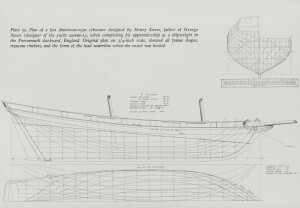 | SHORT DESCRIPTION: Prototype half hull model, starboard side. Howard Chapelle feels this model was for a typical square sterned 12- or 14-gun American schooner of 90’10” length. The model is a basic representation of the vessel's molded lines, without constructional details. The model is not mounted on a backing board. The model may have been varnished at some point in the past but it appears to have been removed. There are some remnants of varnish visible near the stern and around the vessel’s name. It is inscribed in black letters “Built By H. STEERS, 1805.” [see note below] There are decorative flourishes to either side of the date. The model has a slightly raked stem and a square stern with a knuckle in the wedge forming a small counter that begins in lift 13. The counter is 1-7/8”. The transom or upper stern is 1-13/16”. The stem is slightly raked and the bow/entrance is short, only 8” of the model’s 46-5/8” length. The stern is raked. It has moderate deadrise and no tumblehome. The model is constructed of 16 lifts and two wedges between the 14th and 15th lifts. The lower 14 lifts are flat and arranged in pairs each consisting of a 15/16” lift of mahogany and a 1/6” lift in a light colored wood. The bottom lift (1) is flat from the first 10-1/2” from the stern and tapers for 11” (the last inch is missing). It disappears about 17” from the stem. The sheer curve is created by two wedges above the 14th lift. The wedge at the stern is 1-1/8” high and 16-3/4” long and tapers 0”. The wedge at the bow 1-3/4” high and approximately 2’ long and tapers to 0”. Near the center of the model, underneath the words “Built By H” the thin lifts 14 and 15 are touching. Lifts 15 and 16 curve with the sheer created the wedges. The 16th lift is also the top covering for the model, which is not hollowed out to deck level. The dimensions of the model are 46-5/8” (length overall); 5-5/8” (main breadth), 5-1/2” (half breadth). Height overall is 9-5/8” (at the stern). The minimum half-breadth of the model is 1/8" along the edge of the stem and 1/8” at the stern. The lifts are held together nine large pegs running from top to bottom and several small nails appear to be holding the bottom lift in place although these may be part of a later repair. There are a few scattered holes on the top of the model. There are a few variously sized holes whose purpose is not apparent on the back. The model has watermarks running down the center front. There have been some repairs in the past most notably near the stern on the bottom three lifts. There is a small loss at the bow at the ends of the 3rd through 5th lifts. There is some separating between lifts 7 through 9 and the bow and lifts 9 through 12 have what look like repaired cracks at the bow. The tip of the bow at the top has a small loss. The transom also has some small losses along its upper edge. There are a few random nails and holes on the front surface of the model. NOTES: [Willoz-Egnor, 6/18/2022] There is no evidence of dowel channels typical to builder's half-models on this piece. This is backed up by xrays. While this is just a theory, looking at the two engravings showing George and Henry's model rooms, the model does not appear in George's but there is a suspiciously similiar model laying on the floor in Henry's room. You can also see the framed Henry Steer plan of a schooner (1805) in the image of Henry's model room. Might this suggest that Henry (1832-1903) made the model? NOTES: According to the article "Men Who Have Made Yachting: George Steers" by Thomas Day (published in The Rudder, Vol. XVII, February 1906, page 54), Day states that although George Steers undoubtedly worked at all branches of the [shipbuilding] trade, it is probable he was employed chiefly in making models, for it is said that, after he had...proved the possession of an eye for the proper form, he made all of his father's models." According to Dr. Charles K. Stillman in the booklet "The Development of the Builders' Half-Hull Model in America" builder's models most likely began being used in the United States in the late 18th or early 19th century which brings into question the dating of this model despite the presence of the inscription. It is well known that some of the models accumulated by the Steers shipbuilders had been tampered with later in their lives, so its possible the inscription was added much later and stated what was "believed" about the model rather than what was "known." Given Day's comments about George's model making could it be that it represents a model George made of one of Henry's designs? Find a Grave indicates that Henry Steers Sr. was born in 1783 [a ship's manifest for the schooner May Flower dated 1833 supports this, Henry's age is listed as 50] and died in March 1841. He was originally buried in Williamsburg, New York but his remains were moved and moved on March 9, 1870 to Green-Wood Cemetery in Brooklyn (into the J.R. Steers tomb). In 1831 Henry was sent to Mexico by a New York company to seek treasure in a wreck, spending three years in the work and raising a large part of the treasure. The last years of his busy life, to his death in 1841, were spent in similar lines of work, mainly about New York. NOTES: Chapelle believed the model was made from one of the plans drawn by George Steers's father Henry Steers on Isle of Guernsey before he came to America in the year 1819. In the book "The History of the American Sailing Navy" Chapelle states this about Henry Steers: In 1819 an English shipwright named Henry Steer applied for work in the Washington Navy Yard. Steer was born at, or near, Dartmouth, England, in 1780 [1779]. He learned his trade under a builder named Newman in New Quay, and after completing his apprenticeship he went to work in the Plymouth Dockyard. In 1815 he went to the island of Guernsey and worked for the French government. He was not only a shipbuilder, but also a competent draftsman and designer. A fellow shipwright in the Plymouth Dockyard, John Thomas, also a competent builder and designer, had gone to America and was working in the Washington Yard. Thomas wrote Steer suggesting that he come to America and, a depression occurring in the trade in Great Britain at this time, Steer and his family--wife and two sons, James R. and Henry T.--arrived in New York and went from there to Washington. A third son, George, was born in Washington in 1820 [actually 1819]. Henry Steer was employed on the schooners Shark and Grampus, apparently acting as charge man, and remained in the yard until 1822 [actually 1824]. His sons Henry and George became distinguished ship designers. The younger, George, designed the yacht America and many pilot boats, as well as the clipper ship Sunny South. Henry Steers (an "s" having been added to the name by usage) was the designer of the famous Collins steamer Adriatic [nope, it was George] and of many other noted vessels. It has sometimes been claimed that Steer designed the Shark and Grampus, but this can readily be shown to be an error (the vessels were designed by Henry Eckford). Interestingly this book was published in 1949 and in a February 13, 1963 letter to Mr. Robert Burgess, curator of exhibits at the Mariners' Museum, Chapelle states: "I now wonder if it could be a model of the USS Shark which Henry Steers worked on in Washington when he first came to the US." In the article “The Evolution of the American Yacht” by S.G.W. Benjamin in The Century Illustrated Monthly Magazine, Volume 24, pages 355 and 357 Benjamin also discusses Henry Steers and the USS Shark and provides a line drawing of the Shark that matches this model. NOTES: Information from Henry Steers, III: From a journal/autobiography of James Rich Steers transcribed by his son just before his death: "Henry Steers left Plymouth in the spring of 1815 with his family (a daughter, Ann, remained behind in England ) for the Isle of Guernsey, one of the Channel Islands, under contract as a draughtsman for a firm of shipbuilders. These shipbuilders had made contracts with some "French merchants" to build several sailing vessels for them, and to guarantee first speed, second, stability and third, safety. A ship design father had drawn up during his employment at the Royal Plymouth Dockyards in 1805 was accepted by the firm. Three vessels were finished from these lines and accepted." According to family lore these French merchants as it turned out, were smugglers--perhaps the reason that speed was deemed more important than safety. Father also built one bark that was ready to launch by the time he left in April 1819 for Washington. NOTES Text from The Search for Speed Under Sail 1700-1855 by Howard Chapelle, page 189: It has been pointed out that the American sharp seagoing schooner had become so well-known abroad by 1800 that European constructors were able to produce schooners on the American model. Plate 50 is an example. It is a design made in 1805 by an English shipwright apprentice named Henry Steer or Steers. This drawing differs from the original in not showing every frame and in not having the heeled load waterline projected. The original plan seems to have been drawn by Steers as a final examination on completing his apprenticeship. There is no indication that the plan was built from, it was probably a project or a test of seamanship. The plan (plate 50) was for a large 12- or 14-gun schooner of the American model 90’10” between design perpendiculars, 90’10” on the upper deck, 23’2” moulded beam, and 9’9” depth in hold. The design is marked by heavy drag to the keel, strongly raking ends, strong sheer, a midsection formed with sharply rising straight floor, high and easy turn of the bilge, and with some tumblehome in the topsides. The entrance is sharp, convex, and rather short. The run is long and very fine, with hollow in the buttock under the quarters. [Willoz-Egnor, October 2, 2020: The plan Chapelle is referring to is an actual drawn plan that originally came to the Museum with the Steers collection of half models. Unfortunately the plan was loaned to Chapelle for study and was lost. See 1936.1508.000001 for a digital copy.] The projected schooner would have been 82’3” long on the moulded load waterline, with a moulded displacement of 176.3 long tons. Her block co-efficient was .36, her midship coefficient .60, and her prismatic coefficient .59. The effective length of the quarterbeam buttock was about 57’9” and its camber 5’5”, giving a camber-length ratio of 10.7. The apprentice designer of this schooner, Steers, came to America shortly after the end of the War of 1812, and was employed in Washington Navy Yard. He later removed to New York, where he and an associate built the first marine railway in that area. | CL14545 |
Created 2026 by Don Barker, CBMM volunteer, for the Chesapeake Shipbuilding Project. shipbuilding@sailingworkboats.es